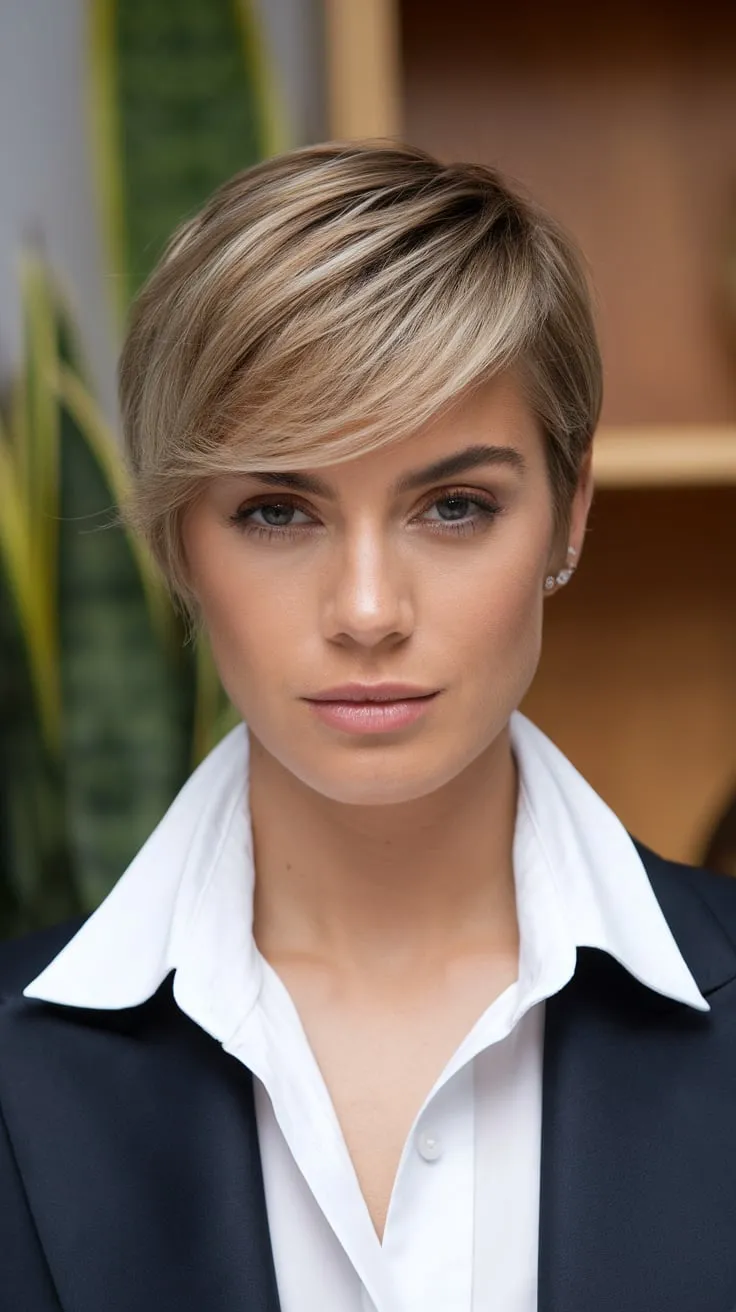
The Authority Signal: How One Deliberate Grooming Choice Can Redefine How the Room Reads You

There is a moment—familiar to anyone who has walked into an important meeting, a high-stakes interview, or a client presentation—when the room forms its first impression before a single word is exchanged. Researchers at Princeton University have documented this phenomenon with striking precision: people draw conclusions about competence and trustworthiness within fractions of a second of visual contact. What those studies rarely discuss, however, is the specific role that grooming plays in shaping those conclusions.
At Salon Monty, we have long believed that every detail defines you. That philosophy is not merely a brand statement—it is a thesis grounded in behavioral psychology, professional sociology, and the lived experiences of clients who have witnessed their careers shift after a single, deliberate appointment.
Why Grooming Operates as a Professional Language
Clothing receives considerable attention in career-coaching literature. Power suits, color psychology in professional attire, and the geometry of a well-tailored blazer have all been analyzed at length. What receives comparatively less scrutiny is the grooming layer—the hair, the skin, the beard, the brow—that frames everything else you wear.
Consider this: your outfit can be impeccable, your credentials unimpeachable, and your handshake firm. Yet if your hair communicates neglect, or your grooming appears inconsistent with the authority you are claiming, there is cognitive dissonance at play. The human brain is extraordinarily sensitive to incongruence. When your appearance tells a fractured story, your audience—consciously or not—resolves that dissonance by downgrading their estimation of your reliability.
Conversely, when every element of your presentation is cohesive and intentional, the brain reads harmony. And harmony, in professional settings, translates directly to perceived competence.
The Specific Decisions That Carry the Most Weight
Not all grooming choices carry equal professional currency. Some are foundational; others are what stylists refer to as "signal decisions"—the specific choices that do the heaviest lifting in terms of perception.
Structural precision in a haircut is perhaps the most universally powerful signal. A cut with clean lines—whether that is a sharp fade, a precisely tapered neckline, or a bob with an intentional silhouette—communicates that you operate with exactness. It suggests that you attend to detail not only in your appearance but in your work. Marcus, a financial advisor based in Chicago, described the shift he noticed after transitioning from a self-maintained cut to a regular appointment with a professional stylist: "My clients started taking my recommendations more seriously. I hadn't changed my pitch. I hadn't changed my process. But something in how they received me had shifted."
Color coherence is another dimension that is frequently underestimated. This does not mean that gray must be covered or that bold color must be avoided. Rather, it means that your color—whatever it is—should appear intentional. Grown-out roots that signal neglect, brassiness that suggests inattention, or fading that implies irregularity all communicate the same underlying message: that maintenance is not a priority. In contrast, a rich, well-maintained tone—whether natural or enhanced—reads as deliberate. It tells a story of someone who follows through.
Grooming symmetry applies most pointedly to facial hair and brow definition. Asymmetry in these areas, even subtle asymmetry, registers subconsciously as disorder. A beard that is shaped with precision, or brows that are groomed with intention, lends the face a composed quality that reinforces the impression of someone who manages complexity with ease.
The Psychology of the Polished Pause
There is a concept in social psychology sometimes called the "halo effect"—the tendency for one positive attribute to elevate our perception of all other attributes in a person. A well-groomed professional benefits from this halo in measurable ways. Studies in organizational behavior have found that individuals perceived as well-presented are more frequently chosen for leadership roles, more readily trusted with sensitive information, and more likely to receive favorable performance evaluations—independent of their actual performance metrics.
This is not a superficial observation. It is a structural reality of how human beings process authority. And it places the grooming appointment in an entirely different category of professional investment.
Amelia, a senior project manager at a Seattle-based technology firm, made a point of scheduling a styling consultation before a major promotion review cycle. "I didn't change who I was," she noted. "But I changed how clearly I was communicating who I was. My stylist helped me understand that I had been presenting myself in a way that was slightly behind where I actually was in my career. One appointment brought those two things into alignment."
What a Strategic Consultation Actually Looks Like
The distinction between a routine appointment and a strategic one lies almost entirely in the conversation that precedes the service. A skilled stylist—one who understands the intersection of aesthetics and professional context—will ask questions that go beyond hair texture and face shape. They will inquire about your industry, your current professional goals, the environments in which you most need to project authority, and the specific impression you are working to create or correct.
At Salon Monty, this consultation process is foundational. The goal is never simply to produce a beautiful result in isolation. It is to produce a result that functions—that works as hard in your professional life as you do. That means considering not only what looks polished in the salon mirror, but what reads with precision and authority in a conference room, on a video call, or across a dining table during a client lunch.
The Cumulative Effect of Consistent Investment
One of the more quietly powerful arguments for regular professional grooming is the cumulative nature of its impact. A single appointment can create a meaningful shift. A sustained commitment to that level of intentionality builds something more durable: a professional reputation that is reinforced, rather than undermined, by every visual impression you make.
This is the compounding return on a grooming investment that most people never fully calculate. The client who maintains a consistent appointment schedule is not simply maintaining their appearance. They are continuously reinforcing a signal—to colleagues, to clients, to decision-makers—that they operate with precision and self-awareness. Over time, that signal becomes part of how they are known.
In a professional landscape where differentiation is increasingly difficult to achieve through credentials alone, the details you bring to your presentation may be among the most accessible and immediate levers available to you.
Your Next Move
If you have been treating grooming as an afterthought rather than a strategy, the recalibration is simpler than you might expect. It begins with a single, unhurried consultation with a stylist who understands what you are trying to accomplish—not just aesthetically, but professionally.
Bring your context to the chair. Describe your industry, your ambitions, the moments in which you most need your presence to land with authority. Allow the conversation to be as deliberate as the result you are seeking.
Because at Salon Monty, we have always understood what the research confirms: where every detail defines you, the most consequential detail may be the one you have not yet given yourself permission to attend to.