Work With What You Have: Embracing Your Natural Hair Texture as a Style Asset
Let us be direct about something the beauty industry has been slow to acknowledge: the decades-long pursuit of a single, homogenized hair ideal has not served most people particularly well. The hours spent with flat irons, the chemical relaxers applied against reluctant curls, the frustration of trying to coax straight hair into voluminous waves it was never designed to hold — much of this effort has been a negotiation with nature, and nature rarely concedes gracefully.
At Salon Monty, where the philosophy has always been that every detail should serve the individual, we have arrived at a professional conviction that feels both obvious and overdue: your natural hair texture is not a starting point to be corrected. It is a distinguishing characteristic to be understood, refined, and celebrated.
This is not a trend piece. It is a practical argument for a more intelligent approach to personal style.
The Spectrum Is the Point
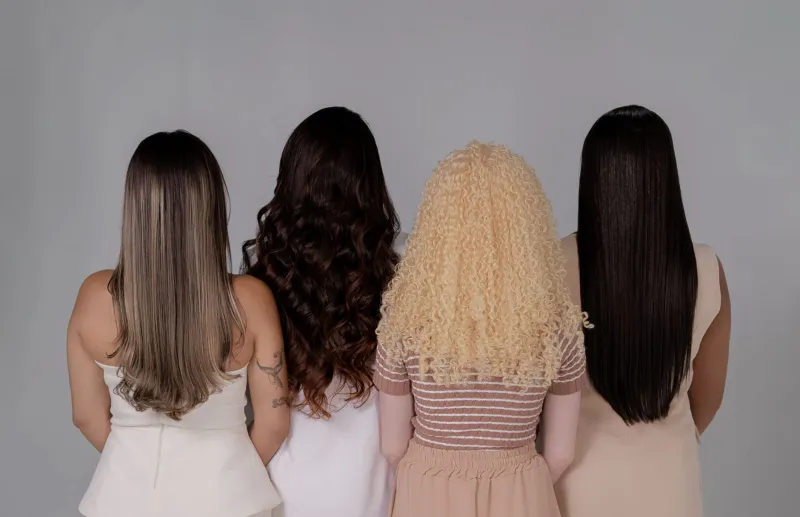
Hair texture exists along a broad and genuinely beautiful continuum. The widely referenced hair typing system — which classifies hair from Type 1 (straight) through Type 4 (tightly coiled), with subcategories denoting curl pattern, density, and porosity — is useful as a starting vocabulary. But experienced stylists will tell you that the system's real value lies not in labeling, but in listening.
Each texture category carries its own structural logic. Straight hair (Type 1) reflects light with exceptional efficiency, lending it a natural luminosity, but may lack the volume that framing a face sometimes requires. Wavy hair (Type 2) occupies a versatile middle ground, responsive to both definition-enhancing products and smoothing techniques. Curly hair (Type 3) possesses a natural spring and dimension that no styling tool can authentically replicate — but it demands specific moisture protocols to perform at its best. And coily, kinky hair (Type 4) — among the most misunderstood and historically underserved texture categories in mainstream American salons — is, in fact, among the most structurally complex and visually striking, capable of styles that range from dramatic volume to refined, sculptural precision.
The spectrum is the point. Diversity of texture is not an inconvenience. It is the raw material of genuinely individual style.
Where Conventional Wisdom Gets It Wrong
For generations, American beauty culture operated on a narrow template. Straight, smooth, and controlled was the implicit standard against which other textures were measured — and often found wanting. The consequences of that standard were not merely aesthetic. For many clients, particularly those with naturally coily or kinky hair, the pursuit of that ideal meant years of chemical and heat damage that compromised the very follicle health we discussed elsewhere in these pages.
But even for clients with wavy or loosely curly hair, the conventional wisdom often led them astray. How many people have spent years straightening hair that, with the right cut and the right products, would have behaved beautifully in its natural state? How many have applied volumizing products to fine, straight hair in quantities that simply created buildup rather than lift?
The problem, in most cases, was not the hair. It was the approach.
The Salon Monty Perspective: Texture-First Consultation
At Salon Monty, every styling relationship begins with what we call a texture-first consultation. Before discussing length, before looking at reference images, before any scissors are lifted, our stylists engage in a structured conversation about the client's natural texture — how it behaves when left to its own devices, how it has been managed historically, and what the client genuinely wants from their hair on an ordinary Tuesday morning.
That last question is frequently the most revealing. The gap between what clients believe they want and what they actually want in terms of daily manageability is often significant. A client who arrives with a photo of a sleek, blown-out style may discover, through honest conversation, that they would be far happier with a cut designed to enhance their natural wave pattern — one that requires fifteen minutes of morning effort rather than forty-five.
This is not about steering clients away from their preferences. It is about ensuring that their preferences are genuinely informed.
Texture-Specific Techniques That Deliver
Once texture is understood, the approach to cut, product, and styling becomes considerably more precise:
For Straight Hair (Type 1): The focus should be on cut geometry. Without curl to create volume, the shape of the cut does the structural work. Layering angles, point cutting, and strategic graduation can introduce movement and dimension that product alone cannot achieve. Lightweight volumizing mousses and dry texturizing sprays are preferable to heavy creams that weigh fine strands down.
For Wavy Hair (Type 2): The curl-enhancing wash-and-go method — applying a light gel or cream to soaking-wet hair and allowing it to air dry without disturbance — frequently produces results that clients have never achieved with blow-dry styling. A cut that removes bulk without removing length allows the wave pattern to emerge cleanly. Diffusing on a low heat setting preserves pattern while reducing drying time.
For Curly Hair (Type 3): Moisture is the governing principle. Curly hair is structurally more porous than straight hair, meaning it loses hydration more readily and benefits from layered moisturizing products — a leave-in conditioner followed by a cream, sealed with a light gel. The Devacurl method and its variations, which involve cutting hair in its natural dry state, have transformed outcomes for many curly-haired clients who previously felt their texture was unmanageable.
For Coily and Kinky Hair (Type 4): This texture category requires stylists with specific expertise and genuine appreciation for its unique properties. Type 4 hair shrinks significantly when dry — sometimes by fifty percent or more of its actual length — which affects how cuts are assessed and executed. Protective styles such as twists, braids, and updos are not merely aesthetic choices; they are strategic investments in length retention and follicle health. Deep conditioning treatments and consistent moisturizing are non-negotiable components of a care routine.
The Authentic Style Outcome
There is a particular kind of confidence that emerges when a person stops fighting their hair and begins working with it. Clients who have made that transition frequently describe it as a relief — a release from a daily effort that was never going to yield the results they were chasing.
At Salon Monty, we have witnessed this shift across clients of every background, age, and texture type. The common thread is always the same: when the style is designed around the hair that actually exists — rather than the hair that convention suggests should exist — the outcome is more authentic, more sustainable, and more genuinely flattering.
Your texture is not a variable to be controlled. It is a characteristic to be known. And at Salon Monty, knowing it fully is where every great style begins.