What the Chair Knows That Your Bathroom Mirror Never Will
The Illusion of Equivalence
It is a reasonable assumption. You have invested in quality tools. You follow tutorials with diligence. You have memorized your product lineup and apply each one with care. On the surface, it seems as though your at-home routine and a professional appointment should produce comparable results—perhaps with the professional visit offering only a modest refinement.
That assumption, however comfortable, is incorrect. The gap between what happens in a well-appointed salon and what occurs in a home bathroom is not merely one of degree. It is structural. It is technical. And in certain respects, it is psychological. Understanding those distinctions is not an exercise in diminishing your personal effort. It is an honest accounting of what professional grooming actually delivers—and why that delivery cannot be replicated by even the most dedicated DIY practitioner.
The Angle Problem No Mirror Can Solve
Begin with something as fundamental as geometry. When you stand before a bathroom mirror, your field of vision is limited to what faces you directly. You can contort, angle a handheld mirror, or rely on a rear-facing camera, but the result is always a fragmented, approximate picture of your own head. A professional stylist, by contrast, moves around you freely. They assess your hair from every angle simultaneously, building a three-dimensional understanding of how your hair falls, where it clusters, and how it behaves under its own weight.
This matters enormously. Hair that appears even from the front may carry an imperceptible graduation at the back that alters the entire silhouette. A cowlick invisible to your own eyes may be directing growth patterns that undermine everything else you are trying to achieve. Professional groomers are trained to read these subtleties not as isolated problems but as part of a unified architectural whole—one they can address with precision because they can actually see it.
The ergonomics of pressure compound this further. Cutting your own hair, or even a partner's, involves awkward angles, inconsistent hand positioning, and fatigue that subtly degrades accuracy over time. A trained stylist works from a position of biomechanical stability, applying consistent tension and pressure across every section. The difference in outcome is not incidental. It is built into the physics of the process.
Tools Designed for a Different Order of Work
The tools available to professionals are not simply better versions of what you find at a retail beauty supply store. They are instruments calibrated for a different category of work entirely.
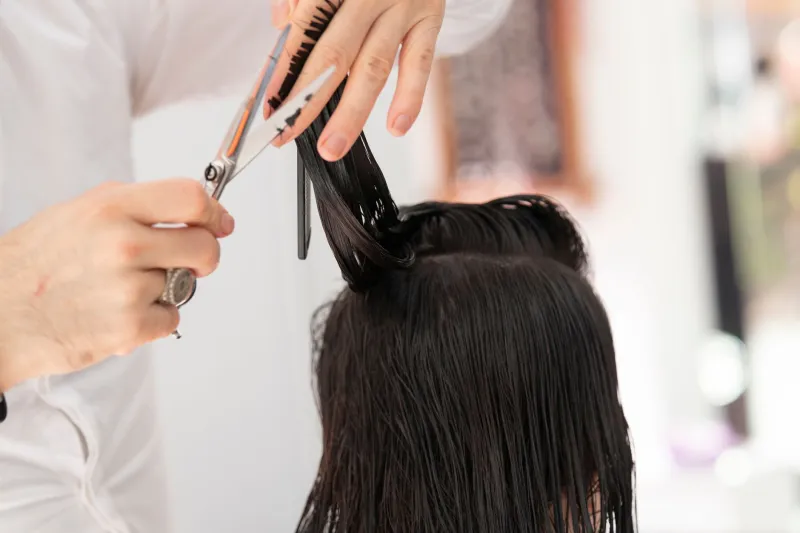
Professional shears, for instance, are engineered to specific tolerances that preserve the integrity of each hair strand during the cut. Consumer-grade scissors, even sharp ones, are more likely to create micro-fractures at the cut point—damage invisible to the naked eye but felt over time as increased frizz, split ends, and diminished shine. Thinning shears used by a skilled stylist remove bulk in a way that honors the hair's natural movement; used without training, they create uneven layers that behave unpredictably as the hair grows.
Beyond cutting tools, professional salons operate equipment—hood dryers, high-velocity blow dryers, steamers, color processors—that simply does not exist in residential settings. These are not luxury additions. They are functional necessities for achieving results that hold. A professional blowout, for example, is accomplished with a combination of airflow velocity, directional nozzle technique, and sectioning discipline that home dryers and brushes cannot replicate, regardless of brand or price point.
Reading Hair in Real Time
Perhaps the most underappreciated element of professional grooming is the diagnostic intelligence that precedes every technical decision. Before a single tool is lifted, an experienced stylist is already gathering information. They assess your hair's porosity by how it responds to water during the shampoo. They evaluate density and elasticity by how it moves through their fingers. They read the scalp's condition, observe the pattern of previous cuts, and note how your hair behaves at different lengths.
This real-time analysis informs every subsequent choice—product selection, cutting technique, heat application, finishing method. It is, in effect, a consultation conducted through touch and observation rather than words. No product packaging, no tutorial, and no amount of personal familiarity with your own hair can substitute for the trained interpretive capacity of a professional who has worked with thousands of different head types across years of practice.
At Salon Monty, this diagnostic approach is foundational to every appointment. The belief that every detail defines you extends to the smallest observable characteristic of your hair—and those observations shape the entire service that follows.
The Environmental Dimension
There is also an environmental component to professional results that rarely receives sufficient attention. Salons are designed to support precision work. Lighting is calibrated to reveal color accurately and expose textural variation. Chairs are positioned and adjusted to maintain optimal working height. Shampoo bowls are engineered for thorough, comfortable cleansing that achieves a genuinely clean baseline—one that most shower routines do not fully replicate.
The products used in professional settings are formulated at concentrations and with ingredient profiles that differ meaningfully from their retail counterparts. A professional conditioning treatment applied under a processing hood, for example, operates under controlled heat and timing in ways that fundamentally alter its penetration and efficacy. The same product applied at home, at room temperature, without proper timing, produces a noticeably different result.
The Psychological Architecture of the Appointment
Beyond the technical, there is a psychological dimension to the salon experience that no at-home routine can reproduce. The act of sitting in a chair, ceding control to a skilled professional, and being attended to with focused expertise creates a distinct mental state. It is not merely relaxation—though that is real. It is the experience of being seen with expertise, of having your specific characteristics assessed and addressed by someone whose entire professional attention is directed at you.
This matters because grooming is not purely cosmetic. It is deeply connected to how we perceive ourselves and how we project that perception outward. The confidence that follows a professional appointment is not simply the result of a better haircut. It is partly the result of having been treated as someone whose details are worth getting exactly right.
Closing the Gap With Clarity
None of this is an argument against maintaining your at-home routine. Consistent care between professional appointments extends results, preserves condition, and demonstrates respect for the work that was done in the chair. But it is an argument for understanding the two practices as complementary rather than interchangeable.
Your bathroom routine sustains. Your salon appointment transforms. Recognizing the difference is not a concession—it is a clarity that allows you to invest in both more intelligently, and to understand precisely what each one is capable of delivering.