The Habits That Age You: What a Skilled Stylist Sees the Moment You Sit Down
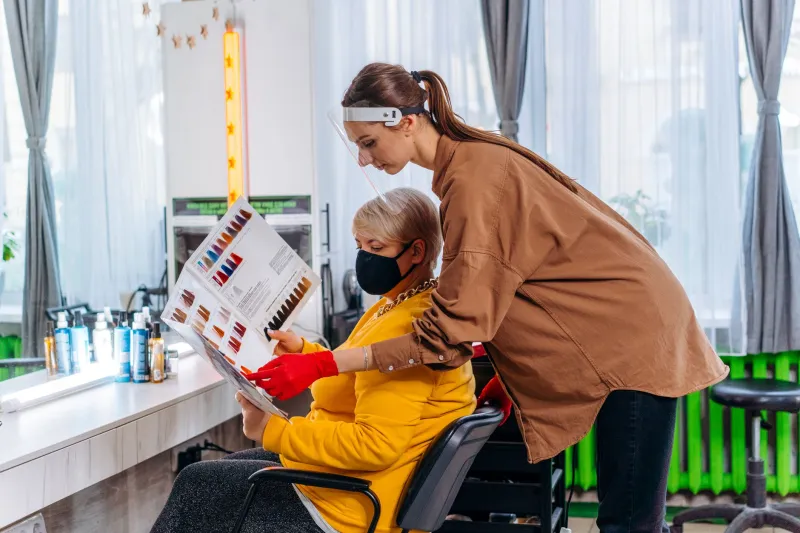
There is a particular kind of honesty that happens in a salon chair. Not the blunt, unsolicited variety—but the quiet, professional assessment that begins before a single word is exchanged. An experienced stylist reads your hair the way a physician reads a chart: methodically, without judgment, and with an eye trained to detect what years of routine have obscured from your own view.
The findings are rarely dramatic. They seldom involve a single catastrophic choice. Instead, they accumulate—a slightly outdated part placement here, an overly aggressive blow-dry technique there, a color that made sense three years ago but no longer flatters the face it frames. Individually, each detail seems negligible. Together, they compose a picture that quietly, persistently adds years to your appearance.
This is the invisible audit. And understanding what a stylist is looking for may be the most useful grooming education you never received.
The Part That Has Stayed Too Still
Few things are as deceptively influential as where your hair is parted. Most people establish a part in their teens or twenties and maintain it, without question, for decades. The hair eventually conforms so completely to this line that changing it feels almost physically wrong.
But hair that falls in an identical pattern year after year begins to betray its age. A deep side part that once looked sharp can, over time, flatten the crown and emphasize the width of the forehead in ways that read as dated. A rigid center part, similarly, can accentuate asymmetries in the face that a slightly adjusted line would soften.
A skilled stylist notices immediately when a part has calcified into habit rather than intention. The solution is rarely radical—a shift of half an inch, a slight alteration in direction—but the visual impact on perceived age and vitality can be striking. Movement and intention in the part signal life. Stasis signals the opposite.
The Blow-Dryer as a Quiet Culprit
The way you dry your hair at home is, for most clients, the single most consistent variable in their daily grooming routine. It is also, according to many professional stylists, one of the most common sources of unintentional aging.
Excessive heat applied too closely and too frequently does more than damage the cuticle. It progressively diminishes the hair's natural movement and luster—two qualities that are strongly associated with youth and health. Hair that has been over-processed by heat tends to sit flat, behave predictably in the wrong way, and resist styling attempts that require any degree of flexibility.
Beyond the heat itself, the technique matters. Dragging the brush downward repeatedly without lifting or rotating causes the hair to lose body at the root—precisely where volume is most aging to lack. A stylist will often observe this pattern immediately in the way a client's hair lies, even when freshly styled. The telltale signs include a compressed crown, ends that curl under without intention, and a general absence of the kind of effortless movement that reads as youthful.
The Color That No Longer Belongs to Your Face
Color is one of the most powerful grooming tools available, and one of the easiest to allow to drift into irrelevance. The shade that suited you brilliantly at thirty-five may, by forty-five, be doing something quite different: pulling warmth away from your complexion, hardening the contrast near your hairline, or simply reading as a color that belongs to a different chapter of your life.
This is not an argument against color, nor a suggestion that gray should be universally embraced. It is, rather, an observation that color requires periodic recalibration as the skin's undertones shift with age. What a trained colorist detects—often before a client has articulated any dissatisfaction—is a growing disconnect between the hair's hue and the face it surrounds.
The adjustment is sometimes subtle: a slight softening of the overall tone, the introduction of dimension where a flat single-process shade has grown monotonous, or a strategic shift toward warmer or cooler territory. The result is hair that appears to work with the face rather than against it—and a complexion that reads as more rested, more vibrant, and measurably more current.
Length That Has Outgrown Its Purpose
There is a cultural assumption, particularly among women, that longer hair is inherently more youthful. Professional stylists encounter this belief regularly, and regularly observe its limitations in practice.
Hair that has been allowed to grow without structural intention can, beyond a certain point, begin to weigh down the face rather than lift it. When length is not supported by the right cut, it pulls the eye downward, elongates the lower portion of the face, and strips the overall silhouette of the lightness that reads as vitality. Split ends and uneven texture, which tend to accumulate with length and irregular trims, further compound the effect.
A stylist assessing a client's length is not simply measuring inches. They are evaluating whether the current length is serving the face shape, the hair's natural density, and the client's lifestyle—or whether it has simply persisted out of habit and a reluctance to let go.
The Texture You Have Stopped Noticing
Over time, most people develop a selective blindness to their own hair's texture. The gradual coarsening that accompanies hormonal shifts, the progressive dryness that results from years of product accumulation, the subtle change in wave pattern that follows a health event or medication change—these shifts occur slowly enough that they rarely register as significant until a professional draws attention to them.
What a stylist observes in these cases is a mismatch between the way a client is caring for their hair and the hair's current actual needs. A moisturizing routine designed for the hair of a decade ago may be entirely inadequate—or, conversely, too heavy—for the hair sitting in the chair today. Products that once produced a polished result may now contribute to the very dullness or frizz the client is trying to correct.
The recalibration required is often modest. A different conditioning approach, a reformulated finishing product, or a technique adjustment at the blow-dry stage can restore a quality of texture that the client had quietly accepted as simply gone.
Why the Professional Eye Matters
The challenge with habits is that they render themselves invisible. A routine practiced daily for years stops registering as a choice and begins to feel like a fact. This is precisely why an outside perspective—particularly one trained to assess the relationship between grooming practice and visual outcome—offers something that no amount of self-examination can fully replicate.
The invisible audit is not a critique. It is a service: the professional act of seeing clearly what proximity and familiarity have obscured. At Salon Monty, this assessment is the quiet foundation of every appointment—the moment before the scissors move or the color is mixed, when a stylist simply looks, and begins to understand what the mirror has been failing to tell you.
Small habits have shaped the way the world perceives you. Small adjustments, made with intention and expertise, can reshape that perception entirely.