Turning Points and the Stylist's Chair: When Professional Grooming Becomes a Necessity, Not a Luxury
There is a particular kind of client who arrives at a salon not quite knowing how to explain what brought them there. They do not come in with a photo saved to their phone or a specific request rehearsed. They come in because something has shifted — a job offer, a breakup, a diagnosis, a promotion — and their reflection has stopped keeping pace with where they are headed. What they are experiencing is not vanity. It is a legitimate, often urgent need for their exterior presentation to align with an interior transformation already underway.
At Salon Monty, this pattern is one the team recognizes immediately. The circumstances vary widely, but the underlying dynamic is consistent: professional grooming stops being optional the moment personal stakes rise high enough.
The Career Pivot That Changes the Equation
Among the most common catalysts for seeking elevated grooming care is a professional transition. This might mean stepping into a management role for the first time, interviewing after a decade in the same position, or launching an independent practice after years working for someone else. In each case, the individual is asking others to see them differently — and appearance is among the first signals that either supports or undermines that ask.
Research in organizational psychology has long established that physical presentation influences perceived competence, authority, and credibility within seconds of an encounter. What is less often discussed is how much that presentation shapes the individual's own behavior. Walking into a high-stakes meeting with a cut that feels intentional and current changes the way a person occupies the room. The grooming is not decorative; it is functional.
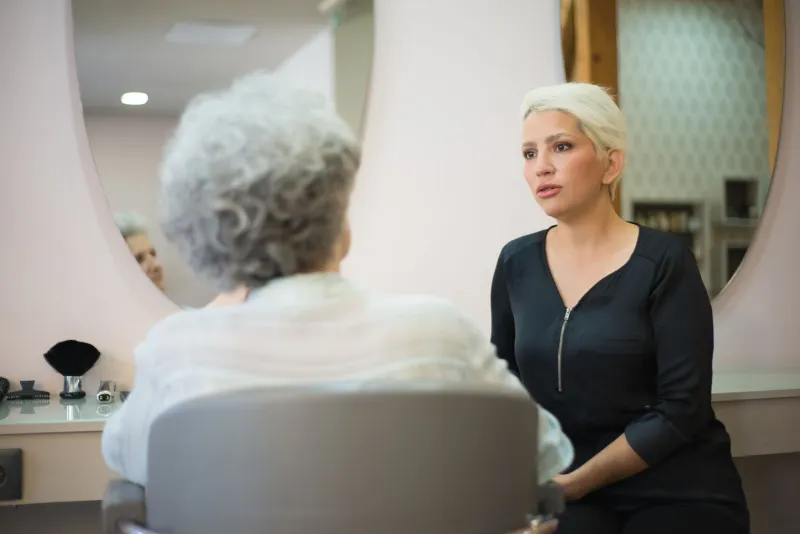
For clients navigating career transitions, the consultation at Salon Monty often becomes a kind of calibration exercise — an opportunity to assess not just what looks good, but what communicates the right things to the right audience at the right moment. That specificity is something no generic styling guide or trend report can replicate.
Relationship Milestones and the Need to Start Fresh
The emotional weight of relationship transitions — whether the beginning of a serious commitment or the end of one — frequently surfaces in the stylist's chair. A client preparing for an engagement, a first date after a long marriage, or simply re-entering social life after a period of withdrawal often arrives with an implicit request: help me look like the person I am becoming, not the person I have been.
This is not a superficial impulse. Identity is expressed and reinforced through appearance, and when the identity itself is in flux, professional guidance offers something more than a haircut. It offers a deliberate point of departure. The service becomes a ritual of transition — a physical marker that separates what came before from what comes next.
The timing here matters considerably. Attempting a dramatic change too early in a personal reinvention, before the emotional clarity has settled, often leads to decisions that feel misaligned weeks later. A skilled stylist reads not just the face and the hair type, but the moment — and adjusts recommendations accordingly.
Health Challenges and the Reclamation of Control
Perhaps the most quietly powerful context in which professional grooming becomes non-negotiable is during or after a significant health challenge. Illness, recovery, hormonal shifts, and the physical changes that accompany major medical events all have visible consequences — changes in hair texture, density, scalp condition, and overall vitality. These are not aesthetic inconveniences. They are experiences that can profoundly affect how a person relates to their own reflection.
Clients navigating these circumstances often describe the same phenomenon: they have lost a sense of agency over their bodies, and professional grooming offers a rare, low-risk opportunity to reclaim some of it. The ability to sit in a chair and make intentional choices about one's appearance — to be seen and attended to with expertise and care — carries a significance that extends well beyond the service itself.
At Salon Monty, the approach to these clients is governed by the same principle that guides every appointment: every detail defines the experience. That means listening more than speaking, recommending with precision rather than volume, and understanding that for some clients, the act of being well-cared-for is as restorative as any specific result.
The Quiet Accumulation of Neglect
Not every inflection point announces itself loudly. Some clients arrive having recognized, gradually and almost reluctantly, that their grooming routine has quietly collapsed under the weight of a demanding life. The pandemic years accelerated this pattern for many Americans — remote work removed external accountability, and the habits that once structured personal presentation simply dissolved.
The return to professional care in these cases is often described as a kind of awakening. Clients speak of forgetting what it felt like to be genuinely attended to, to have someone with real expertise evaluate their hair and scalp and offer solutions tailored specifically to them. The reintroduction to that standard of care frequently catalyzes broader changes — renewed attention to health routines, wardrobe, sleep, and overall self-regard.
This is the infrastructure argument for professional grooming that rarely appears in mainstream beauty coverage: consistent, expert care creates a feedback loop. It raises the baseline from which every other self-maintenance habit operates.
Recognizing Your Own Inflection Point
The question worth sitting with is not whether professional grooming matters — the evidence for that is substantial. The more useful question is whether you are currently at one of these thresholds, and whether your current routine is equipped to meet what that moment actually requires.
Career transitions, relationship milestones, health recoveries, and the slow erosion of a once-reliable routine all share a common feature: they represent moments when the cost of inaction is higher than it appears. The grooming audit no one tends to conduct honestly is the one that asks not just what am I doing but is what I am doing adequate for where I am going.
For those who find themselves at such a threshold, the stylist's chair is not an indulgence. It is infrastructure — a starting point for the next chapter, attended to with the precision and intentionality that the moment deserves.