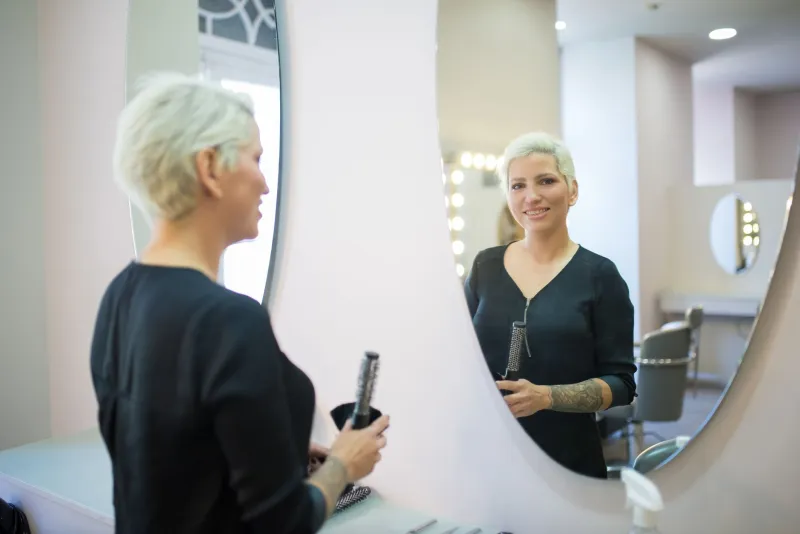
Silver as a Statement: How Embracing Gray Hair Became the Ultimate Expression of Confidence
For decades, the American beauty industry operated on a single, largely unquestioned premise: gray hair was something to be managed, minimized, and — whenever possible — erased. The shelves of every drugstore in the country stocked the evidence. Root touch-up kits. At-home color systems promising to restore the "you" that time had allegedly diminished. The cultural message was clear, if rarely spoken aloud: silver was a problem awaiting a solution.
That premise is now unraveling at remarkable speed.
Across professional offices, social gatherings, and the broader cultural landscape, a growing number of Americans are making a different choice. They are keeping their gray. They are styling it intentionally. And in doing so, they are rewriting what silver hair communicates about the person wearing it.
The Psychology of Letting Go — and What It Signals
The decision to stop coloring one's hair is rarely purely aesthetic. For many, it represents something far more interior: a deliberate refusal to perform a version of youth that no longer feels authentic. Psychologists who study self-presentation and identity have long noted that appearance choices carry significant psychological weight — not merely in how others perceive us, but in how we perceive ourselves.
When someone chooses to embrace their natural graying rather than conceal it, they are, in effect, making a public declaration of self-acceptance. That act requires a particular kind of courage in a culture that has historically equated visible aging with diminished relevance, particularly for women. To wear silver hair without apology is to reject that equation entirely.
What many discover in the process is something unexpected: a sense of authority they had not anticipated. There is a particular confidence that accompanies the decision to stop hiding. It reads, to those around you, as someone who has arrived — not at an ending, but at a settled, assured sense of self.
What Professional Stylists Are Seeing in the Chair
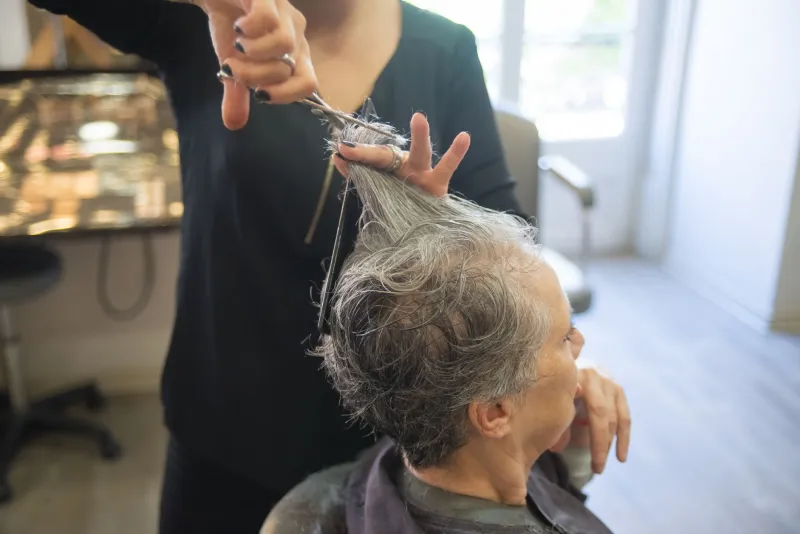
At salons across the country, stylists have observed a marked shift in the conversations clients are initiating. Where consultations once centered almost exclusively on color maintenance and root concealment, they now frequently involve something more nuanced: how to make the transition gracefully, and how to style silver hair so that it functions as an asset rather than an afterthought.
The techniques involved are genuinely sophisticated. Gray blending — the practice of working with a client's natural silver in a way that creates dimension, softness, and intentional variation — has become one of the most technically demanding services a colorist can offer. It requires an understanding of undertones, of how silver interacts with light, and of how to create results that feel deliberate rather than neglected.
Full silver acceptance, on the other hand, calls for its own set of considerations. The texture of gray hair often differs meaningfully from its pigmented counterpart — it can be coarser, drier, and more prone to frizz. A skilled stylist will address those realities through conditioning treatments, toning services that neutralize unwanted yellow or brassy tones, and cuts designed to work with the hair's natural behavior rather than against it.
The result, when executed with care, is striking. Silver hair that has been properly maintained and styled carries a luminosity that few other looks can replicate.
Generational Change and the Cultural Shift Underway
It would be a mistake to attribute this movement solely to any single generation. While younger Americans — particularly those in their thirties and early forties who began graying prematurely — have been notably visible in championing silver hair on social media, the shift spans a much wider demographic.
Women in their fifties and sixties who spent years faithfully maintaining color appointments are quietly reconsidering whether those appointments still serve them. Men who once reached for grooming products designed to obscure their temples are choosing instead to lean into the salt-and-pepper aesthetic that, frankly, has always carried a degree of cultural cachet for them — though the conversation around that double standard is its own important thread.
What is changing most significantly is the cultural narrative itself. Silver hair is appearing with increasing frequency in advertising campaigns, on the covers of major publications, and on the most visible stages of American professional and public life. Each appearance chips away a little further at the assumption that gray must be hidden to be acceptable.
Challenging the Invisibility Myth
Perhaps the most persistent — and most damaging — narrative surrounding gray hair is the idea that it renders its wearer invisible. This notion has particular force for women, for whom aging has historically carried social penalties that their male counterparts largely escape. The fear, stated plainly, is that silver hair will cause others to look through you rather than at you.
The reality, as observed in professional environments and social contexts alike, appears to be precisely the opposite. Individuals who wear their gray with evident intention and confidence tend to command attention rather than deflect it. There is something about the combination of silver hair and deliberate presentation — a well-executed cut, a polished overall aesthetic — that reads as formidable rather than faded.
This is, in part, why the salon experience matters so deeply in this context. Embracing gray is not the same as abandoning care. The most compelling silver looks are the ones that have been considered, shaped, and maintained with the same rigor one would bring to any other aspect of personal presentation. The statement is not "I have stopped paying attention." The statement is "I am paying attention to something different now — and it is more honest."
The Role of the Consultation in a Gray-Forward Journey
For anyone considering the transition — whether from full color coverage to gradual blending, or from blending to complete silver acceptance — the conversation with a skilled stylist is essential. Every head of hair grays differently. The distribution of silver, the underlying texture, and the individual's skin tone all influence which approach will yield the most flattering result.
At Salon Monty, that consultation process is where the real work begins. Understanding not just what a client wants to look like, but why this choice feels meaningful to them, allows a stylist to bring genuine intentionality to the result. A silver transformation executed with that level of care is not merely a color decision. It is a collaboration in self-expression.
A New Definition of Polished
The broader lesson embedded in this cultural moment is one worth sitting with: polish has never been synonymous with conformity. The most compelling personal style has always been the kind that reflects something true about the individual wearing it.
For a growing number of Americans, silver hair is exactly that — true. It is the color their hair has become, worn without apology, styled with intention, and offered to the world as evidence of a life fully and unapologetically lived.
That, by any measure, is a power move.