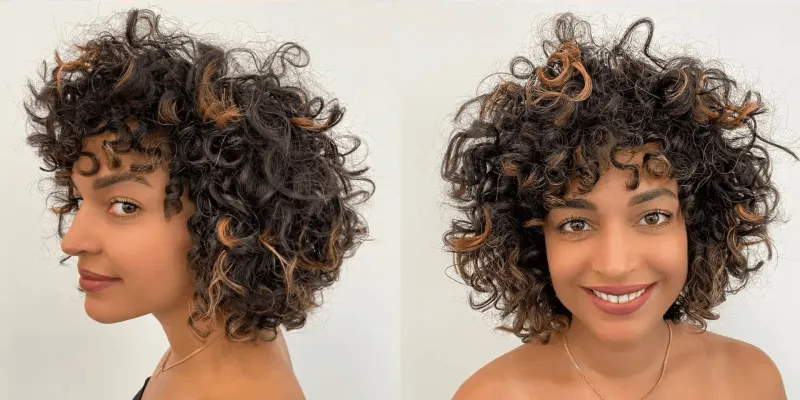
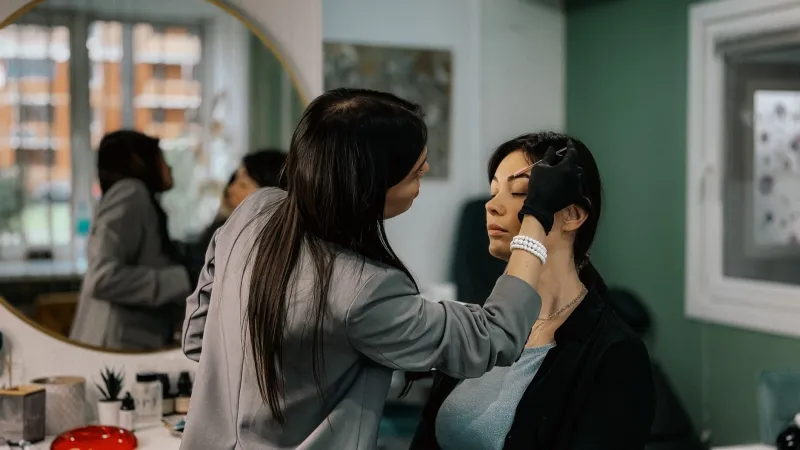
Standing Taller: The Surprising Science Behind How Your Haircut Affects Your Posture
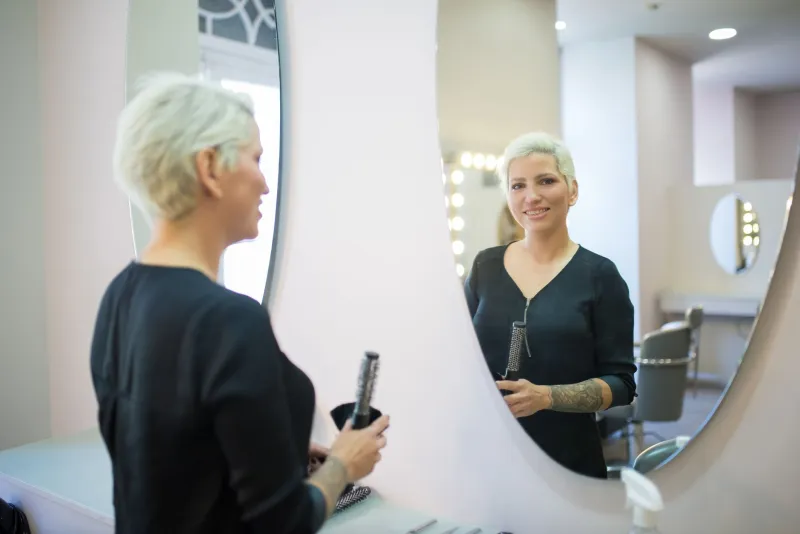
There is a moment that happens in the salon chair—familiar to anyone who has experienced a truly transformative appointment—when the stylist turns you toward the mirror and something shifts. Not just your reflection, but your spine. Your shoulders drop away from your ears. Your chin lifts almost imperceptibly. You sit differently. You breathe differently. It is not vanity at work. It is neuroscience.
At Salon Monty, we believe that every detail defines you—and few details are as quietly powerful as the relationship between how you are styled and how you hold yourself in the world. That relationship, it turns out, runs in both directions.
The Body Reads the Mirror
Researchers in social and cognitive psychology have long studied the connection between physical appearance and self-perception. One of the most compelling findings in this space is that self-image does not merely live in the mind—it is expressed through the body in real time. When you feel well-presented, your nervous system registers that information as a form of social safety. The body relaxes. Protective tension in the shoulders and neck releases. Posture opens.
This is not a small effect. Studies examining what psychologists call "enclothed cognition"—the way physical appearance influences mental state—have shown that people who feel put-together demonstrate measurably different behavioral patterns than those who feel disheveled. They make more eye contact. They speak with greater authority. They occupy space with more intention. And crucially, they stand taller.
Your hair, as the most visible and personally expressive element of your appearance, carries an outsized share of this psychological weight.
Why Hair Sits at the Center of Self-Perception
Unlike clothing, which you choose each morning, your hair is with you constantly. It is the first thing others notice at eye level and the last thing you adjust before walking into a room. When it is working against you—whether grown past its ideal shape, weighed down by product buildup, or simply not reflecting who you are—your body registers that dissonance. Often unconsciously, you begin to compensate. You might tilt your head forward, pull your shoulders inward, or avoid eye contact in a way that reads to others as disengagement.
Conversely, when your cut is precise, your color is intentional, and your style is aligned with your identity, the body stops compensating. It simply presents. That ease of presentation is what most people describe as "confidence," but it is more accurate to call it congruence—the feeling that your exterior matches your interior, and that no apology is necessary for taking up space.
The Feedback Loop in Action
Here is where the science becomes genuinely compelling: the relationship between styling and posture is bidirectional. A great haircut can improve your posture, yes—but practicing better posture can also deepen your appreciation for your style and make you more likely to invest in maintaining it.
Research from Harvard Business School and other institutions has demonstrated that expansive, upright physical postures—what some researchers call "power poses"—actually alter hormone levels, increasing testosterone and reducing cortisol in ways that make people feel more assertive and less stressed. When you stand tall, your brain receives physiological confirmation that you are capable and present. That state of mind makes you more attuned to the details of your appearance, more willing to make eye contact, and more inclined to see your own reflection favorably.
In practical terms, this means that the client who walks into Salon Monty already carrying themselves with intention tends to walk out feeling even more elevated by their appointment. And the client who arrives feeling uncertain often finds that a skilled stylist—through the quality of the work and the attentiveness of the consultation—can initiate that postural shift before they even leave the chair.
What a Skilled Stylist Actually Sees
Experienced stylists understand, even if they do not always articulate it in clinical terms, that they are working with the whole person—not just the hair. At Salon Monty, our approach to every appointment begins with observation. How does this person hold their head? Where does their natural part fall? How does their neck line interact with their jaw? These are not purely aesthetic questions. They are structural ones.
A cut that is calibrated to your natural posture and movement will always outperform one that looks perfect only when you are standing perfectly still. When your stylist accounts for how you actually carry yourself—the slight forward tilt you have when you are deep in conversation, the way you push your hair back when you are thinking—the result is a style that works with your body rather than against it. And a style that cooperates with your body is one that reinforces your posture rather than undermining it.
Practical Steps for Strengthening the Loop
Understanding this connection is useful only if you act on it. There are several ways to begin reinforcing the relationship between your styling choices and your physical presence.
Be honest in your consultation. When you sit down with your stylist, share not just what you want your hair to look like, but how you want to feel. Words like "sharp," "relaxed," "authoritative," or "effortless" give your stylist meaningful direction that goes beyond length and texture.
Notice your posture when your style is fresh. Pay attention to how you hold yourself in the days immediately following an appointment. That physical openness is data—it tells you what your ideal style actually is, regardless of what you thought you wanted.
Practice posture awareness as a grooming ritual. Before you leave the house, take thirty seconds to stand straight, roll your shoulders back, and look at yourself fully in the mirror. This is not vanity. It is calibration. You are confirming that your exterior is aligned with your intention for the day.
Return to the salon before the dissonance sets in. Many clients wait until their style has fully grown out or faded before booking their next appointment. By that point, the postural compensation has already begun. Regular maintenance appointments—whether for a trim, a gloss treatment, or simply a blowout—keep the feedback loop active.
The Detail That Holds Everything Together
At its core, the connection between your hair and your posture is a story about coherence. When the details of your appearance are intentional and well-maintained, your body does not have to work to overcome them. It is freed to simply be present—upright, open, and fully expressed.
That is the philosophy at the heart of Salon Monty. Every cut, every color, every carefully considered styling choice is an investment not just in how you look, but in how you move through the world. Because where every detail defines you, even the angle of your shoulders tells a story. Make sure it is the one you intend to tell.