When Your Hair Stops Cooperating: Navigating the Biological Shifts That Rewrite Your Midlife Routine
There is a particular kind of frustration that arrives somewhere in your forties or fifties. The products that served you faithfully for decades suddenly feel wrong. Your curl pattern loosens — or tightens. Hair that was once reliably straight develops an unexpected wave near the temples. Strands that used to hold moisture now feel perpetually parched, regardless of how many conditioning treatments you apply. And volume, once effortless, seems to require twice the effort for half the result.
This is not a failure of your routine. It is biology, working precisely as designed.
At Salon Monty, we believe that where every detail defines you, the details of your hair's behavior deserve a thorough, honest explanation. The midlife changes you are experiencing are not random. They are the product of shifting hormones, evolving nutritional needs, accumulated stress, and — in many cases — the medications used to manage the very conditions that midlife brings. Understanding these forces does not simply explain the frustration. It opens a path toward a strategy that works with your hair as it is now, rather than against the hair it used to be.
The Hormonal Architecture of Your Hair
Hair follicles are exquisitely sensitive to hormonal signals. Estrogen, in particular, plays a sustaining role in the hair growth cycle — prolonging the anagen, or active growth, phase and contributing to the diameter and elasticity of each strand. During perimenopause and menopause, estrogen levels decline significantly, and the effects on hair are both structural and behavioral.
As estrogen decreases, androgens — male hormones present in all bodies — become comparatively more influential. This shift can cause follicles to miniaturize over time, producing finer, shorter strands with each successive growth cycle. The result is a gradual but noticeable reduction in density, particularly along the crown and part line. Simultaneously, reduced sebum production — itself partly regulated by hormonal balance — leaves strands more prone to dryness, brittleness, and breakage.
For those who experience thyroid imbalances during midlife, an additional layer of complexity emerges. Both hypothyroidism and hyperthyroidism can disrupt the hair growth cycle, leading to diffuse thinning, changes in texture, and increased shedding. If your hair changes feel sudden or particularly pronounced, a conversation with your physician about thyroid function is always worthwhile.
The Curl Pattern Conversation Nobody Warned You About
Perhaps the most disorienting change for many clients is the unexpected alteration of curl pattern. Hair that was pin-straight for forty years may develop a persistent wave. Curls that were once defined and springy may loosen into something undefined and frizz-prone. These shifts are real, documented, and tied directly to changes in the follicle's shape.
The cross-sectional shape of a hair follicle determines the degree of curl it produces. Hormonal fluctuations during midlife can subtly alter this geometry, shifting the follicle's angle or shape and, in turn, changing the behavior of the strand it produces. Additionally, changes in the hair's internal protein structure — specifically the distribution of disulfide bonds within the keratin — affect how strands respond to humidity, heat, and styling.
This is why a curl-enhancing product that once produced beautiful results may now create frizz, and why a smoothing routine that worked flawlessly may leave hair feeling flat rather than sleek. The hair itself has changed, and the products and techniques applied to it must change accordingly.
Stress, Nutrition, and the Compounding Effect
Hormones do not operate in isolation. The midlife years frequently coincide with elevated and sustained stress — professional demands, caregiving responsibilities, life transitions — and chronic stress has a well-documented impact on hair health. Elevated cortisol levels can push follicles prematurely into the telogen, or resting, phase, resulting in increased shedding known as telogen effluvium. The hair loss associated with this condition is typically diffuse rather than patterned, and it often appears two to four months after the triggering stressor, making the cause difficult to identify without some reflection.
Nutrition adds another dimension. Iron, zinc, biotin, and protein are among the nutrients most directly tied to hair growth and structural integrity. Midlife brings shifts in absorption efficiency, dietary patterns, and in some cases, the nutritional side effects of long-term medications. Statins, blood pressure medications, antidepressants, and hormonal therapies can all influence hair texture, density, and growth rate. If you have recently introduced or adjusted any medication and noticed a corresponding change in your hair, that connection is worth raising with both your prescribing physician and your stylist.
Recognizing the Shift Before Frustration Sets In
The most effective strategy is early recognition. Hair rarely changes overnight; the process is gradual, and the early signals are easy to dismiss as a bad hair day or a product gone wrong. A few indicators deserve attention:
- Increased shedding during washing or brushing that persists for more than a few weeks
- A widening part line or reduced density at the crown
- Altered drying behavior — hair that once air-dried smoothly now dries with texture, or vice versa
- Resistance to familiar styling techniques that previously required no effort
- Persistent dryness that does not resolve with conditioning
When these signs appear, the instinct is often to reach for a new product. While targeted products can provide relief, they rarely address the underlying shift. A professional consultation is a far more efficient first step.
Evolving Your Strategy With Professional Guidance
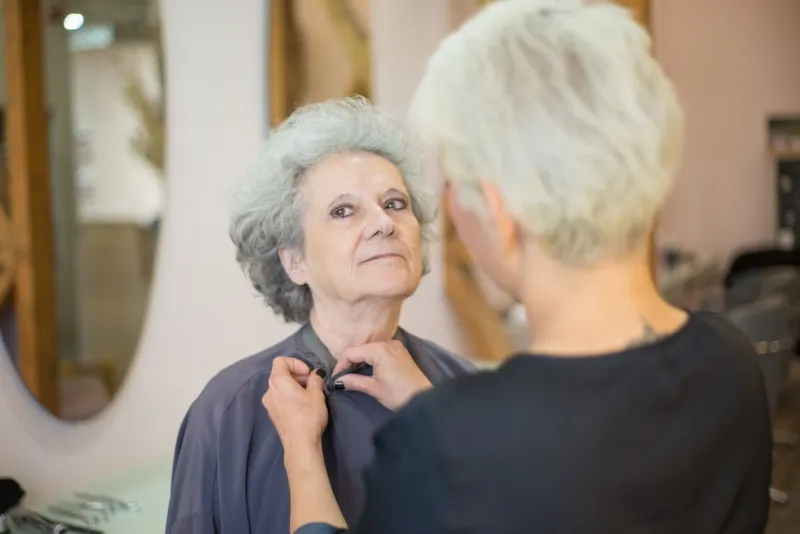
At Salon Monty, the consultation is the foundation of every appointment — and nowhere is that foundation more critical than when a client's hair is in transition. A skilled stylist approaches midlife hair changes not as a problem to be corrected but as a new set of parameters to work within. The conversation should cover texture behavior, density changes, current products, health context, and styling goals.
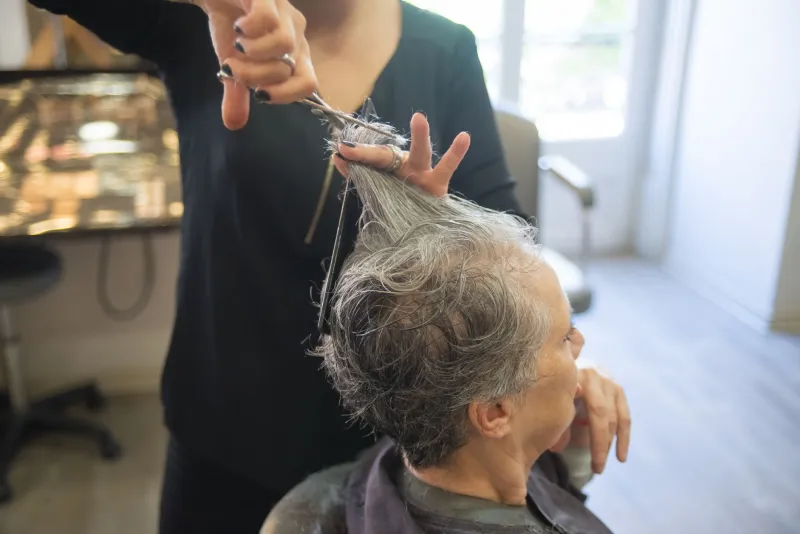
From there, the strategy may involve a revised cut that works with reduced volume rather than fighting it — shorter lengths that remove weight and restore the appearance of fullness, or layering techniques that enhance emerging wave patterns rather than suppressing them. Color adjustments can also play a meaningful role; certain tonal choices and highlighting placements create the optical impression of dimension and density that naturally thinner hair may lack.
Product recommendations shift as well. Midlife hair typically benefits from lighter, moisture-rich formulations that do not weigh strands down, bond-building treatments that reinforce structural integrity, and scalp-focused care that supports the follicle environment from which every strand originates.
A New Relationship With Your Hair
The most important reframe available to anyone navigating midlife hair changes is this: the goal is not to restore the hair of twenty years ago. It is to cultivate the best possible version of the hair you have now. That distinction matters enormously, both for the practical results it produces and for the relationship it fosters between you and your reflection.
Your hair's evolution is not a loss. It is a transition — one that, approached with the right knowledge and the right professional partnership, can yield a look that feels entirely intentional. At Salon Monty, that partnership is what we are here to offer: the expertise to read what your hair is telling you, and the skill to translate that into a strategy as refined and considered as you are.